
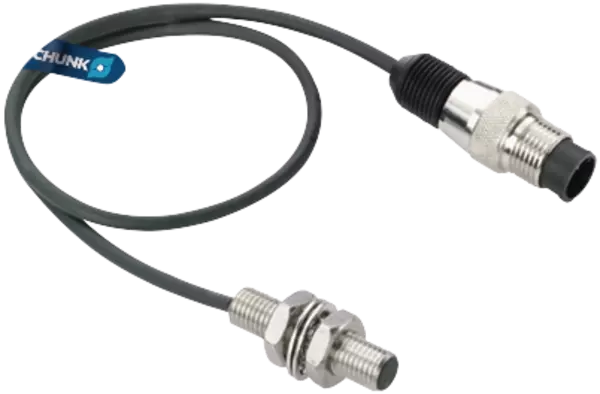
IN
Induktive Näherungsschalter
Induktive Näherungsschalter werden eingesetzt, um den gegenwärtigen Zustand von Automationskomponenten abzufragen. Sie werden von SCHUNK in den Versionen IN und INK angeboten. Die Version IN ist direkt steckbar oder verfügt über ein angegossenes Kabel mit Steckverbinder. Zur direkten Verdrahtung eignet sich die Version INK, die über ein angegossenes Kabel mit offenem Ende verfügt.
Beschreibung
Vorteile – Ihr Nutzen
- Befestigung über Halter
für die einfache und schnelle Montage - Ausführung mit LED-Anzeige
zur Kontrolle des Schaltzustandes direkt am Sensor - Ausführung mit Standard-Steckverbinder
für einfache und schnelle Austauschbarkeit des Verlängerungskabels - Hochflexibles Kabel in PUR-Ausführung
für eine lange Lebensdauer - Näherungsschalter bündig einbaubar
für geringe Störkonturen in der Applikation
Optionen und spezielle Informationen
- Funktionsbeschreibung
Induktive Näherungsschalter erzeugen mit ihrer Oszillatorspule ein hochfrequentes, magnetisches Wechselfeld. Dieses Feld tritt an der aktiven Fläche des Sensors aus. Dringt ein metallenes Objekt in das Feld ein, dann entzieht es dem Magnetfeld Energie, dadurch verkleinert sich die Schwingungsamplitude. Diese Änderung wird erkannt, der Sensor schaltet. - Signalausgang und Schaltungsart
Je nach Baugröße und Ausführung des Sensors sind diese mit den Signalausgängen Öffner oder Schließer und in den Schaltungsarten PNP und NPN verfügbar. Bitte sprechen Sie uns an. - Hohe Schutzart
IP67 in gestecktem Zustand für den Einsatz in sauberer oder staubiger Umgebung bzw. bei Kontakt mit Wasser. Die Funktionsfähigkeit bei Kontakt mit anderen Medien (Kühlschmierstoff, Säuren, Laugen usw.) ist häufig gegeben, kann von SCHUNK aber nicht garantiert werden.