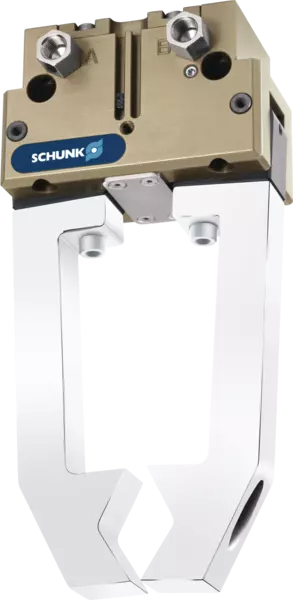
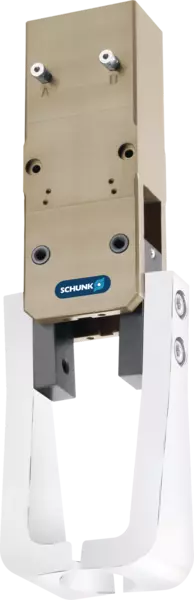
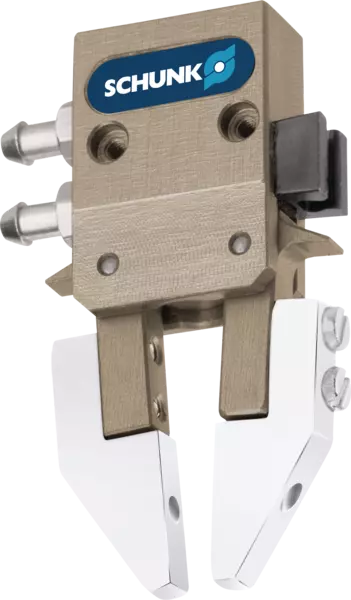
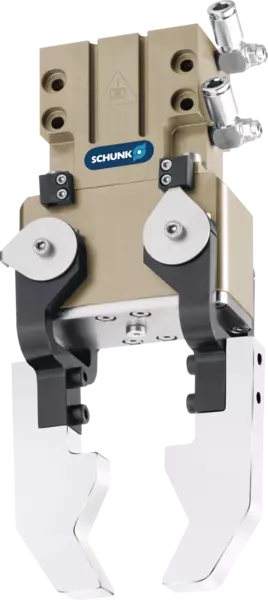
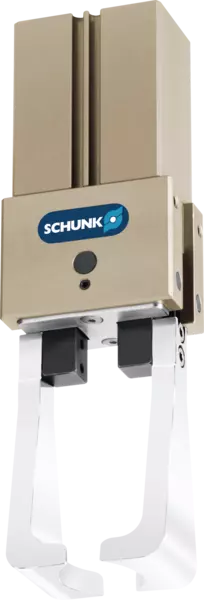
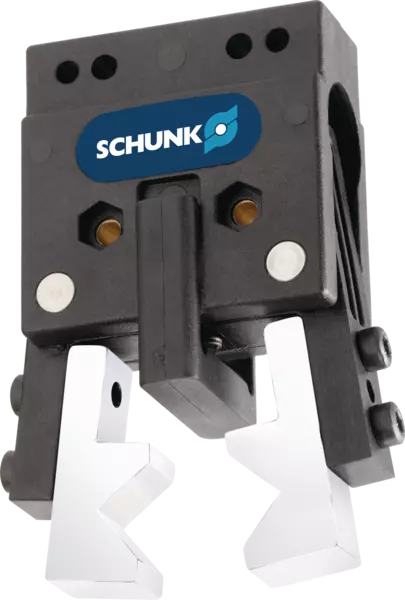
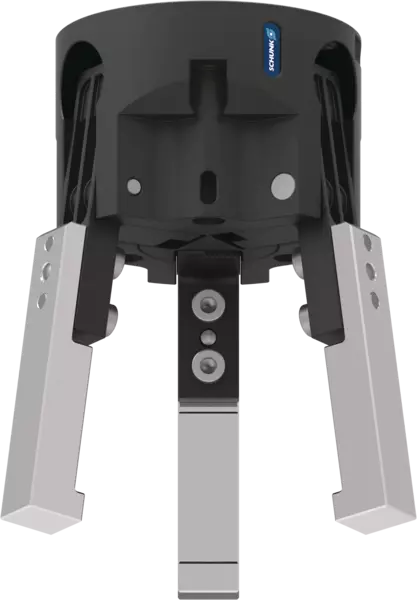
Our standard range of angular grippers includes small-component, universal, large-stroke and sealed grippers with 2- or 3-fingers for safe, precise handling of workpieces with different weights. They can be used in a wide range of applications, from electronics assembly and packaging technology to loading and unloading machine tools. The ability to combine a gripper with elements such as sensor systems, product-specific gripper fingers or plastic inserts offers increased productivity, While innovative design tweaks such as the positively guided toggle drive system allow precise, synchronized gripping for greater process reliability.
In the event of energy or pressure loss, seven variants secure the gripping force and/or the current position:
AS (spring closing)/IS (spring opening): A spring holds the gripper closed or open with minimum force. S (spring closing/opening): Depending on the design of the top jaws, the spring acts as a closing or opening mechanism. ASC (certified spring closing)/ISC (certified spring opening): The certified GripGuard gripping force maintenance ensures at least 80% gripping force in the closing or opening direction in the event of a pressure drop. M (permanent magnetic brake): Maintains the gripping force in the closing and opening direction. KP (position clamping): Fixes the current position in the closing and opening direction – via a brake or a pneumatic clamping element.
is calculated for force-fit clamping with a coefficient of static friction of 0.1 and a safety factor of 2 against workpiece slippage at acceleration due to gravity g. In the case of form-fit gripping, significatnly higher permissible workpiece weights are possible.
Example: - For the catalog-specified workpiece weight of 5 kg Gripping force of the gripper 1,000 N Coefficient of friction μ 0.1; safety factor 2; g 9.81
The ambient temperature describes the temperature of the air or the direct operating environment in which a gripper is operated (and not the workpiece temperature, as this is normally significantly higher than the ambient temperature). We also offer special solutions for ambient temperatures above 130 °C. We would be happy to review your use case based on your specific process data.