
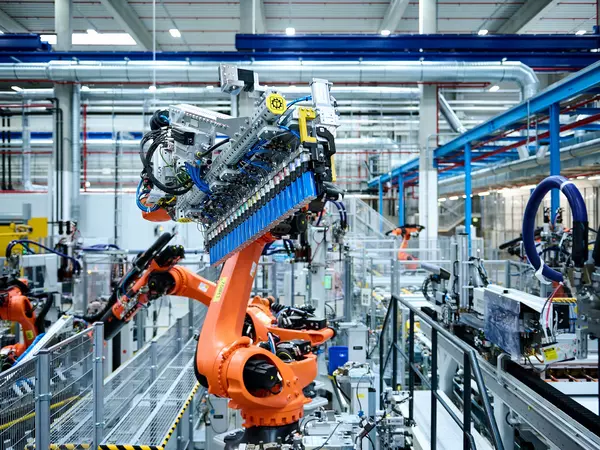
Batteries are the energy storage devices of a sustainable future. They power electric vehicles, stabilize power grids, and secure the supply of industrial plants and private households. Without powerful, cost-efficient batteries, the energy transition would be inconceivable. As a result, manufacturers are under significant pressure: the market is growing rapidly, demand is rising, and innovation cycles are becoming shorter. To remain competitive, they must automate production at the highest technical level – while operating in an environment that is exceptionally sensitive.
Because battery cells are manufactured in processes that push the limits of what is physically possible: wafer-thin materials, micrometer-precise positioning, stringent cleanliness requirements, and high cycle rates. Any deviation - every particle, every minor inaccuracy - can compromise quality, and even render entire batches unusable. Automation in cell production therefore means process reliability under cleanroom conditions combined with maximum efficiency. Three success factors determine whether this is achieved: cleanliness, precision, and production speed.
The sensitivity of battery cell manufacturing can be illustrated by a single example: the separator – the ultra-thin membrane between anode and cathode – measures only 12 to 25 micrometers. If even a single particle enters this layer, it can pierce it and cause a short circuit. The cell becomes unusable; in the worst case, later operation can even result in a safety-critical situation.
The same level of caution also applies to the upstream step in the process chain: the so-called roll-to-roll-manufacturing. Here, the likewise extremely thin anode and cathode foils – sometimes only 8 to 18 micrometers thick – are continuously coated and further processed over a distance of several meters. Even the slightest particle contamination or temperature fluctuations can lead to coating defects.
Therefore, cell assembly takes place exclusively under strictly controlled conditions. Cleanrooms prevent particles from the surrounding environment from entering the process. Dry rooms protect sensitive electrode materials from moisture. Even the slightest traces of water could react with the electrolyte, cause chemical instabilities, or, in the worst case, trigger fires. In practice, this means humidity levels comparable to those in Antarctica – i.e., dew points of -40 to 70 degree Celsius – are standard.
These environments place specific requirements on the automation technology. Moving parts must not emit any particles, and lubricants must function even under extremely dry conditions without containing any chemically reactive components. SCHUNK has integrated these conditions into its product development from the ground up. The company’s grippers, clamping technology, and linear axes are designed, tested, and certified for cleanrooms and dry rooms. Components relevant to cell manufacturing are tested for particle emissions at the Fraunhofer-Institute for Manufacturing Engineering and Automation IPA.
Materials play a key role in battery cell manufacturing, and copper and zinc alloys are taboo because, in combination with the cell materials, they can cause corrosion and lead to corrosive deposits. Instead, SCHUNK relies on AW7075 aluminum alloy, which is not only high-strength and corrosion-resistant, but also suitable for all cleanroom applications when combined with high-quality anodization. Even the lubricants are specially selected: they contain no lithium to prevent chemical interactions and retain their lubricating properties even at minimal humidity levels. This prevents wear or particle emissions under the extreme conditions of a dry room.
Electrostatic charge is just as critical as particles and moisture. In the extremely dry atmosphere of dry rooms, friction can quickly cause voltage to build up, damaging sensitive cell components or destroying entire batches. That is why solutions for cell manufacturing must be designed to meet ESD protection requirements. They enable the controlled dissipation of electrical charges and minimize the risk of uncontrolled discharges.
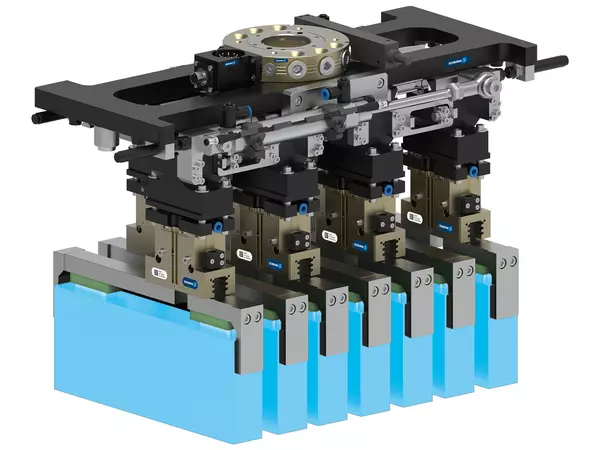
Cleanliness in battery manufacturing is not an added benefit, but a fundamental quality attribute. Every automation component – from the gripper and linear axis to the clamping device – becomes part of the cleanliness concept.
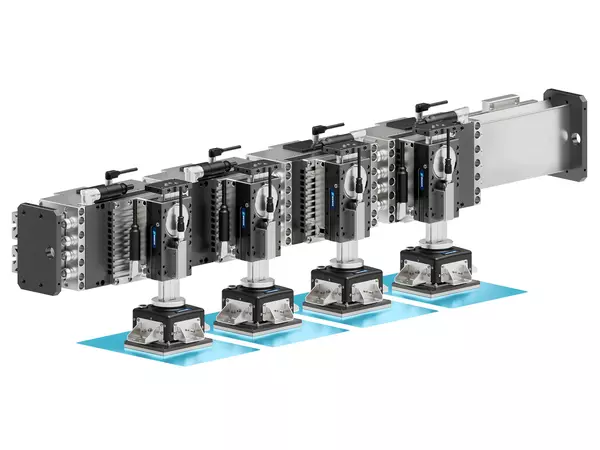
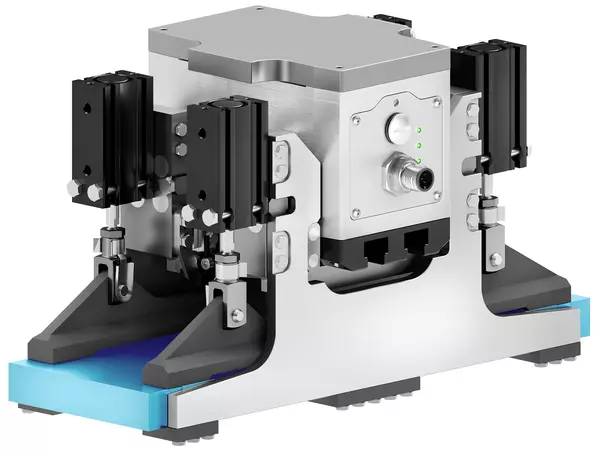
In hardly any other industry does the exact position of each component have such a direct impact on quality and yield as it does in battery cell manufacturing. Particularly in so-called stacking processes, where anodes, cathodes, and separators are stacked in layers, the demands are enormous. Each layer must be precisely positioned, automatically corrected if necessary, and secured in place. A minimal deviation is enough to create electrical or mechanical imbalances – and the cell fails the quality inspection. Handling so-called jelly rolls – the rolled electrode used in cylindrical cells – as well as cell stacks formed in prismatic cells and during Z-folding also demands the utmost precision. These sensitive structures respond to pressure, temperature, and electrostatic loads. SCHUNK grippers are designed to safely handle and precisely position these components in line with requirements such as maximum surface pressure or a defined gripping range. The gripper solutions always operate with minimal offset and maximum repeatability. Compensation units absorb manufacturing tolerances or vibrations without damaging the sensitive cells. In electromechanical clamping systems, integrated sensors ensure that every clamping process is monitored and documented – a decisive advantage for traceability and process reliability.
Precision also plays a central role in machining. In slitting – that is, the precise cutting of electrode foils – run-out accuracy and minimal vibration are critical. In this case, SCHUNK relies on hydraulic expansion technology, which dampens tool vibrations and enables run-out deviations of less than three micrometers. This results in consistently clean cutting edges and thus reproducible quality across millions of cells.
Precision in battery cell manufacturing doesn‘t just mean accuracy in each individual process step. It needs to extend across the entire process chain – from coating and stacking to final inspection. Only when all movements, forces, and positions are perfectly coordinated, the end result is a battery that is reliable, durable, and safe.
The global demand for battery cells is growing rapidly. Forecasts assume that demand will multiply by 2030. At the same time there is a significant price pressure – not only in the automotive sector. Utilities, equipment manufacturers, and energy storage system providers are competing for production capacity – those who can produce faster have a clear cost advantage.
The challenge is to achieve a high cycle rate despite sensitive materials and extremely tight tolerances. In modern stacking, cycle times of under 0.4 seconds per electrode sheet are achieved today. With several hundred layers per cell, this adds up to a highly dynamic process in which any delay has noticeable economic consequences.
However, in this industry, speed must never come at the expense of quality. The “sweet spot“ is where maximum dynamics and precise control don’t exclude each other, but rather reinforce each other. SCHUNK addresses this trade-off with technologies that enable speed while ensuring process stability.
One example is the linear direct drive axes, which provide maximum rigidity and repeat accuracy at extremely short cycle times. They achieve speeds that would otherwise only be possible with pneumatic systems, while remaining fully electronically controllable and free of compressed-air particles – a clear advantage for battery cell manufacturing.
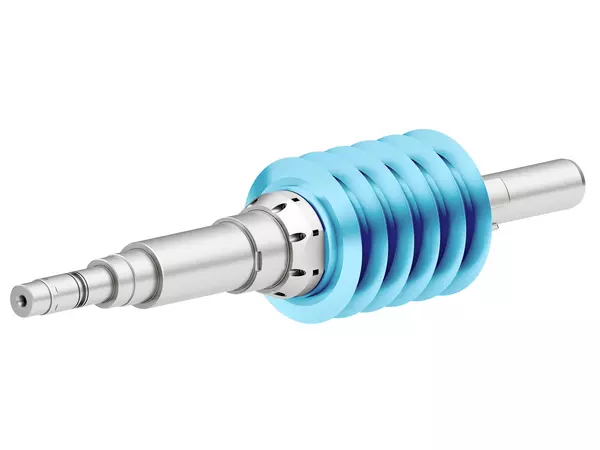
Another crucial factor is the setup time. In slitting – the precise cutting of coated electrode webs – cutting blades are used and must be replaced regularly. With SCHUNK’s hydraulic expansion arbors, the setup time can be completed in no time: tools can be released and clamped again quickly, without any readjustment. This reduces downtime and maximizes system availability.
In addition, the modular SCHUNK systems enable parallel processing lines – multiple cells can be handled or stacked simultaneously. Combined with sensor-based condition monitoring and predictive maintenance, production speed can be kept consistently high without risking any loss of quality.
Battery cell manufacturing is at the heart of the energy transition – and at the same time one of the most demanding industrial disciplines of our time. Processes must be extremely clean, precise, and fast in order to deliver high-quality and cost-efficient cells. Automation solutions that master this tread are the key to success.
SCHUNK has established itself as a reliable technology partner in this environment. With a deep understanding of the physical, chemical, and mechanical requirements of cell manufacturing, the company develops systems that operate just as reliably in cleanrooms and dry rooms as they do on high-speed lines. High-quality materials, intelligent sensor technology, precision mechanics, and a modular design – all of these elements help manufacturers worldwide to stabilize and scale their processes.
This means SCHUNK delivers far more than just components: the company supports the battery industry on its path toward sustainable, efficient, and safe production – making it an important enabler of a climate-friendly, economically viable future.