
Whether for personal or commercial use, the demand for plastic containers that safely store and reliably transport products remains as strong as ever. Otto Hofstetter, a manufacturer of injection molds and press dies, has noticed this as well. "Our production in the Mold and Toolmaking division is operating at full capacity," says Roger Winkler, head of soft machining at the company in Uznach, Switzerland. "In addition to high demand and an increasing variety of designs, we also have to cope with seasonal fluctuations in orders. That's why we needed significantly more flexibility in our automation." The production team had to handle an increasing number of component variants in order to cover the entire product portfolio. "The result is a comprehensive modernization, in which we have been able to replace previous machining machines with a modern automation system," says Winkler.
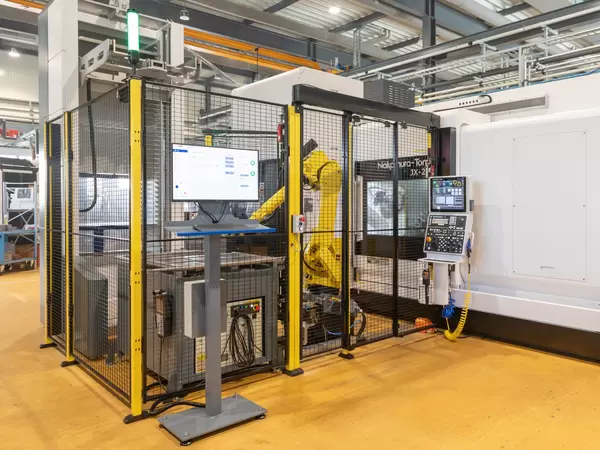
An application-specific robotic cell was developed for fully automated machine loading in cooperation with R. WICK, a custom machine manufacturer based in Küssnacht. "Its biggest advantage," emphasizes machine operator Enzo Helbling, "is that we can now create, prioritize, and process several different jobs one after another – with fully automated changeovers, for example overnight or over several days." The deputy head of the soft-machining department at Otto Hofstetter is enthusiastic about the new system: "When a job is completed, there isn't – as there used to be – any downtime because the machine has finished; instead, the system automatically changes over and moves on to the next job on its own."
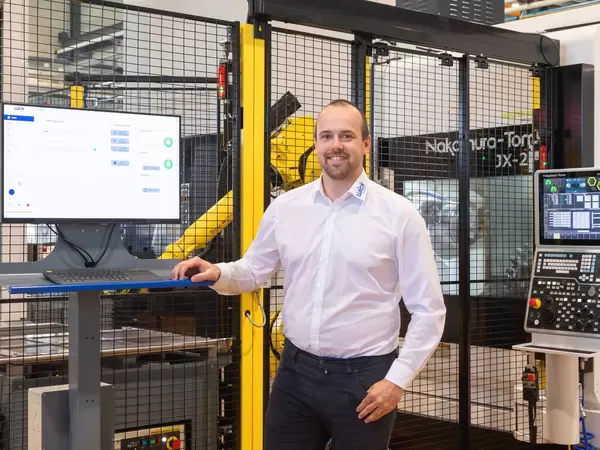
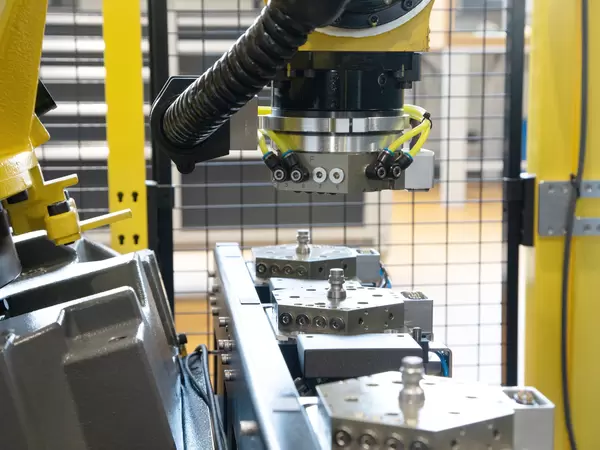
The primary task for R. WICK was to automatically feed various parts into the machine in variable quantities and remove them again – fully automatically and with minimal setup effort. "We wanted to build the entire automation system using standardized components as far as possible in order to achieve simplicity," explains Kevin Heinzer, project manager at R. WICK, describing the approach. He was primarily responsible for designing the system. "For the Fanuc M 710-ic 70, a standard multipurpose robot with 70 kilogram load capacity, we had to find a suitable tool changer." We've known SCHUNK since 2000 and have remained completely loyal to them ever since because their products and our working relationship are simply a perfect fit. "We came across the new CPB change system at the automatica 2025," reports Kevin Heinzer, "and it was just right for us." Until then, WICK had installed a predecessor product from SCHUNK in its robot cells. "But the new CPB immediately appealed to us because it is compact, offers versatile media feeding options, and is easy to integrate." Another advantage for system integrators is the lighter weight of the CPB's aluminum housing, which now allows for a higher handling weight.
One particularly convincing feature of the CPB is the robust locking mechanism with a pin. Here, SCHUNK has applied its more than twenty years of technological experience in stationary workholding in the development and has thus transferred the proven system from the machine table to the robot. "We knew this system with clamping pins from the VERO-S NSR pneumatic robot coupling," Heinzer continues. "This is reliable technology with an effective locking mechanism offering a reliable process, even in the event of an unexpected drop in compressed air pressure. We really liked it." The form-fit locking, self-retaining pin mechanism made of vacuum-hardened stainless steel offers maximum stability and a long service life. The clamping pin enables simple joining behavior with high repeat accuracy – even with tilt angles and center offset, it allows fast and secure joining. Even when it came to the details, the design engineers on both sides worked together with user satisfaction in mind: some electrical contacts were implemented by the customer using spring pins, while others used SCHUNK components. The result is a compact, closed system with external media feed-throughs outside the CPB, adapted to WICK standards.
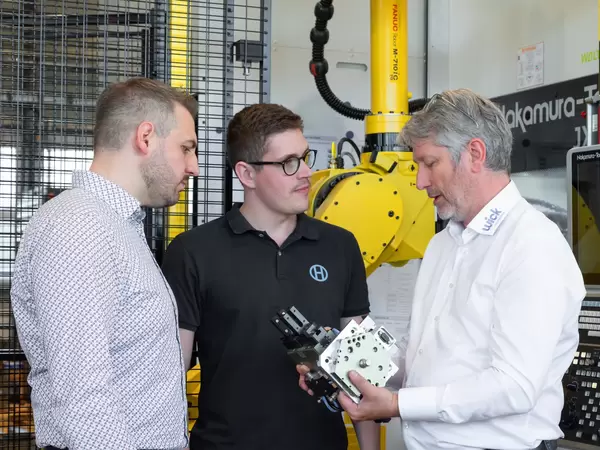
The CPB system, consisting of a robot-side interchangeable head and a tool-side interchangeable adapter, offers users maximum flexibility while ensuring process reliability. "With this tool changer, the robot is now able to carry out different handling or processing tasks flexibly and without additional set-up work," explains Guido Lüönd, Technical Director at R. WICK. "Using a customized storage rack with CPB adapters and different grippers, Otto Hofstetter can now handle an entire range of variants with just a single tool changer. That makes a lot of sense and is a crucial milestone on the path to greater standardization, simplicity, and minimized downtime," emphasizes Guido Lüönd.
The complete system centered around the new Nakamura-Tome JX-250 five-axis turning/milling center, including the slim six-axis robot, the gripper storage rack, and the pallet station with storage rack tower, was delivered at the end of 2025 and has been operating smoothly and without any malfunctions since February 2026. It now replaces three previous machines. While standard parts are fed through a bar feeder, the robot can simultaneously load and unload the machine. This combination gives Otto Hofstetter maximum flexibility: both standard parts and component variants in small batch sizes can be processed efficiently. "This is the most state-of-the-art system we currently operate here," Enzo Helbling assures us. "The error-free operation, comfortable handling, and easy conversion thanks to the tool changer save a lot of time and increase our productivity thanks to the short idle times. It's a lot of fun to work on this system."
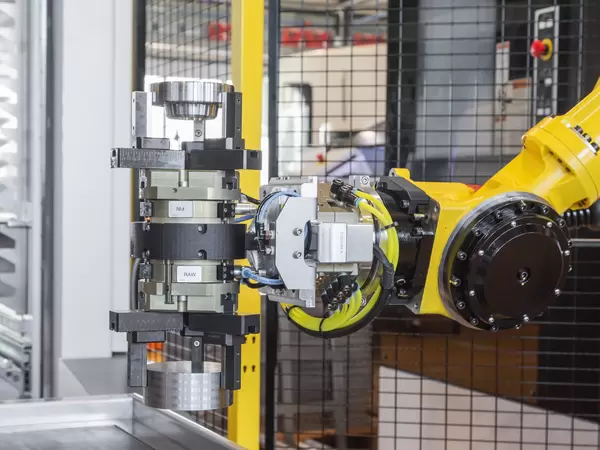
The pallets with raw parts are loaded manually at the storage rack tower. From there, the robot retrieves the parts and, after processing them, places them back in their designated locations fully automatically. The robot takes the required gripper from the storage rack; it is assembled for the specific application and can be adapted depending on the component range. "We've had a good working relationship with SCHUNK for years and always have the right gripper models in use," emphasizes Guido Lüönd. On the Hofstetter system, the SCHUNK benchmark PGN-plus-P gripper with customized gripper fingers and the JGZ centric gripper are currently in use, among others. SCHUNK offers a perfectly coordinated and efficient tool change with suitable gripping technology and the CPB change system from the Robot PLUS portfolio.
"Our modernization project has been a great success thanks to this new system," concludes Roger Winkler. "With the combination of the automation cell and CPB tool changers, we now manufacture with significantly greater flexibility. The automated variant changeover with minimal setup effort increases our efficiency. WICK and SCHUNK have impressed us – both technically and in terms of the collaboration among all parties involved. We feel we're getting the perfect level of support!" The machine builder WICK also highlights the strong partnership: "Our reliable collaboration leads to solutions that are consistently tailored to the user's needs. That's why we'll continue to rely on changers and grippers from one source – at SCHUNK, we know exactly what we're getting."