
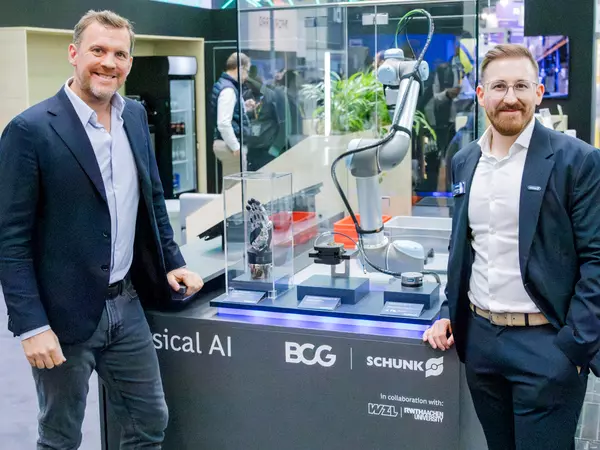
If physical AI meets decades of expertise in gripping and automation technology, this is where new capabilities emerge: systems become adaptive, processes more robust, and robots act more and more autonomously. This helps companies tackle key challenges in production more effectively – from skilled labor shortages and increasing costs to complex, variable handling tasks that push classic automation to its limits. To make it easier for companies to get started with automation, SCHUNK works closely with partners across consulting, technology and research. This collaborative approach bundles expertise and creates practical, quickly implementable levers of efficiency – for higher productivity, faster imple-mentation, and greater operational resilience.
Within the framework of Hannover Messe, SCHUNK and Boston Consulting Group (BCG) announced a strategic collaboration to accelerate the adoption of physical AI in manufacturing. The goal is to bring AI-powered robotics from simulation into real production environments faster. Together, the two partners aim to help customers identify high-impact automation opportunities, develop proof-of-concept solutions, and scale industrial applications. BCG contributes expertise in AI, digital trans-formation, and process, while SCHUNK brings its know-how in automation and industrial applications.
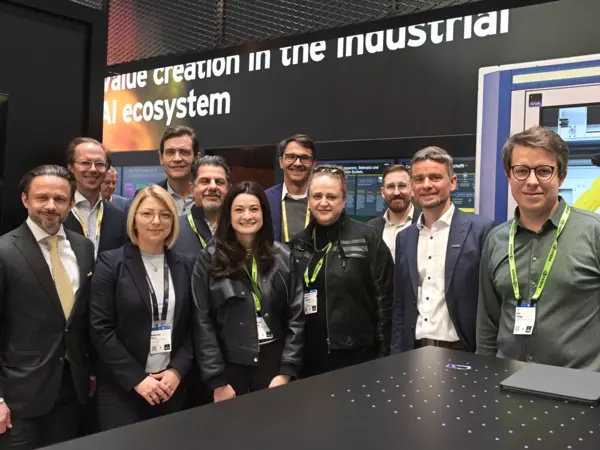
SCHUNK collaborates with EY, NVIDIA, and Wandelbots to scale physical AI for the mid-sized European companies, leveraging NVIDIA technology. Central to this is the modular SCHUNK GROW automation cell, a standardized production unit for handling, assembly, and inspection. With the integration of NVIDIA Omniverse libraries and the NVIDIA Isaac open simulation framework, the cell – including its robot motions, gripping processes, and complete workflows – can be virtually modeled, trained, and validated. This reduces risk, shortens commissioning time, and stabilizes process start-up. Wandelbots contributes the NOVA platform for software-defined robot control and data integration, while EY is responsible for the operating model and go-to-market strategy.
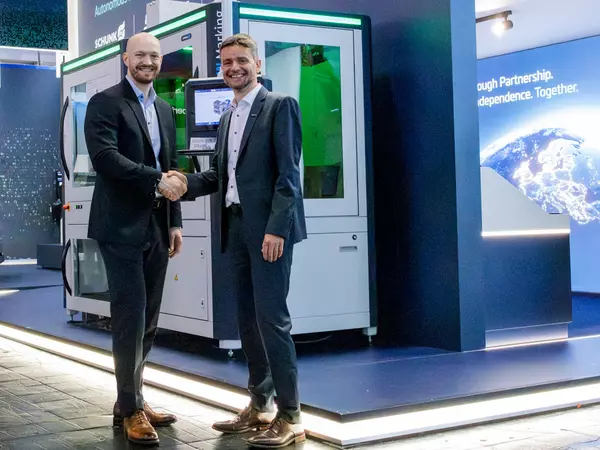
Together with STACKIT, the cloud provider of Schwarz Digits, Cybus, and with the support from Next Level Mittelstand, SCHUNK provided a preview of a scalable smart factory solution for SMEs. As the center was the AI-powered GROW automation cell, which represents a complete production step: components are supplied via a palletizing module, handled by a robot using a gripper, and then precisely laser-marked. In a visualization, multiple GROW cells were combined into a ”smart micro factory.“ The open system can be seamlessly integrated into additional automation cells or third-party systems, making sovereign, rapidly scalable smart factory scenarios for SMEs tangible in practices.
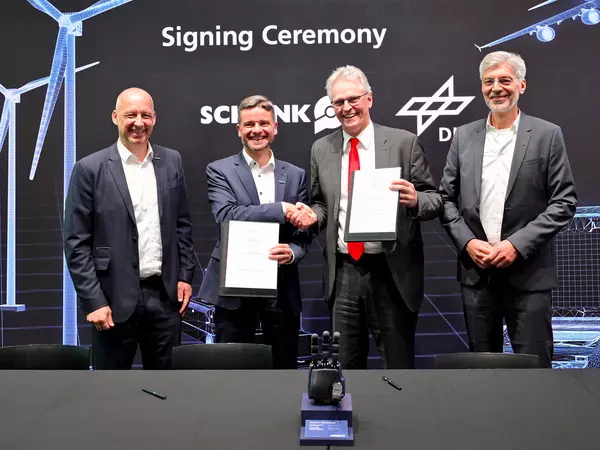
SCHUNK signed a license agreement at the Hannover Messe with the German Aerospace Center (DLR) covering robotic hand technologies developed as part of the “SmartHand” project. Based on DLR technology, SCHUNK will further develop its modular, humanoid robotic hands, particularly their fine motor skills for industrial applications. With this cooperation, the two partners build on nearly 20 years of close collaboration and now aim to combine mechanical expertise with cutting-edge robotics research and AI to solve demanding automation tasks in practical, real-world applications.