
Our customers receive orientation and security throughout the entire course of the project – from the first meeting to concept validation and commissioning. We work with a clear, transparent process. This means that they always know the status of the project, what milestones are coming next, and what results they can expect. It is also important for us to look at the big picture. We don't just focus on individual component, but on the entire process: cycle times, quality, component variants, interfaces. This results in automation solutions that not only work, but are also economical and future-proof. And because the mechanics, actuator, sensor, and software systems come from one source, we minimize interface risks and maximize performance. In the end, it should be one thing above all for the customer:
predictable and reliable – even if the project is complex.
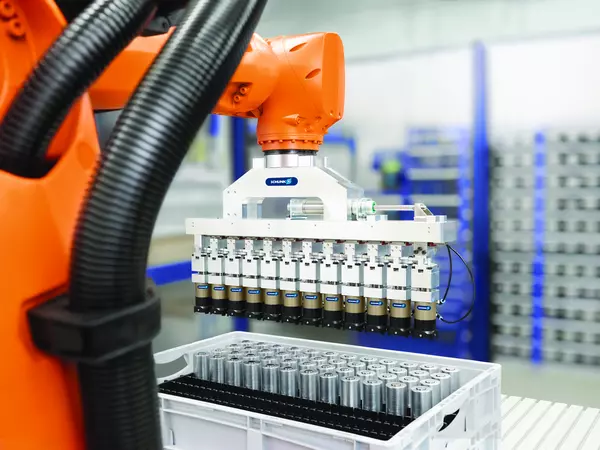
To be honest, it always starts with listening. In the initial discussions, we carefully record targets, restrictions, and KPIs – from cycle time and accuracy to the range of components and compliance requirements. We reflect back the challenges and translate them into concrete solutions. This could be a configurable individual component, such as an electric gripper with integrated condition monitoring. Or it could be a complete automation solution, featuring highly dynamic axis systems and complex assembly modules. We are particularly strong in the combination of gripping technology, toolholding and workholding: the reliable transfer between machining and assembly is a critical aspect that we address holistically. Our broad industry expertise – from automotive and electric mobility to medical technology and electronics – flows directly into our concept work. This means we work with best practices instead of experiments. Customers realize early on that this is well-founded, feasible, and tailored to their process.
With proximity and standards. We have engineering hubs and CoLabs in key regions around the world, and are therefore physically close to our customers. This allows us to test applications, carry out training, and implement changes quickly. At the same time, all teams work according to harmonized design guidelines and uniform quality and documentation standards. Shared data and requirements platforms, digital review boards and customer approvals keep everyone involved in sync – regardless of the time zone. The project is managed centrally by an experienced project management team and implemented locally by regional teams. This ensures speed on site while maintaining global quality. A concrete example: for a multi-site roll-out, we introduced identical assembly and test cells in Europe, Asia and North America – with the same key performance indicators, local service, and central change control.
In short: with discipline, transparency, and the right tools. We work to clear milestones – from the specifications and design freeze through to acceptance at our factory and support until the start of production. Each milestone is backed up with clear criteria, risk and change management. Our production network is scalable, the supply chain is qualified and there are uniform quality standards. Technically, we go as far as possible in the preliminary test: we use digital twins, cycle time and collision simulations as well as the emulation of axis systems to check stability and performance before the first real set-up begins. We attach great importance to early validation and traceability – all requirements are consistently reflected in tests and approvals. In this way, we avoid late surprises and meet deadlines.
In everyday life, partnership is characterized above all by continuity and reliability. Our customers have dedicated contacts, receive fast support, and benefit from local maintenance concepts. We stay with the systems for years if necessary. If products, cycle times, or quality targets change, we adapt systems – without disruption and with a view to availability, OEE, and total life cycle costs. One point that is often underestimated is documentation. Drawings, parts lists, parameters, and setup data remain traceable and reliable even many years later, and are therefore still reliable even many years later. And we empower the teams: training courses for operators, maintenance and engineering – on site, in the CoLab or digitally – ensure that the solution has maximum impact in everyday life. In short: we are staying, and we are keeping the performance up.
We combine in-depth industry and application knowledge with a structured, globally scaleable engineering process to create customized automation solutions that deliver measurable added value, from components to complex assemblies.