
Automation does not always start at the most spectacular points of a manufacturing facility. Often, the greatest potential lies in areas where processes have been functioning reliably for years but involve a great deal of manual labor: loading and unloading parts, marking, assembling, inspecting, lubricating, or packaging. Such activities are necessary, but they generate only limited additional value. Simultaneously, they can become a bottleneck if the preceding processing steps are already highly productive and largely automated.
SCHUNK faced this situation in its own toolholder production facility at its Lauffen am Neckar site. There, toolholders are manufactured with high precision, a wide variety of variants, and a high manufacturing depth. With 149 machines, 34 robots, and about 400 employees, the facility is already highly automated. Nevertheless, the finishing process involved several manual steps: balancing, laser marking, oiling, and packaging. Laser marking, in particular, became a limiting factor.
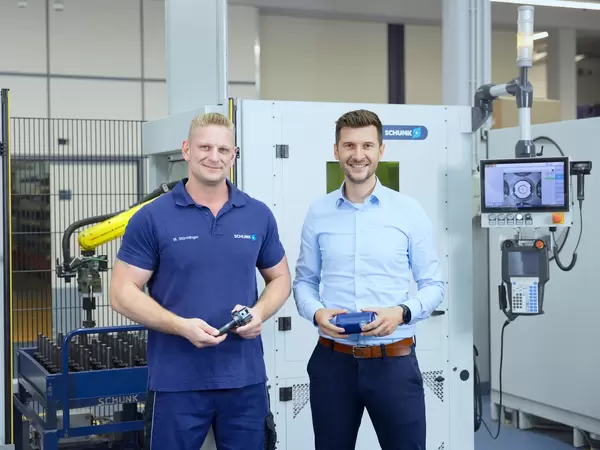
Martin Stürmlinger, a finishing specialist at SCHUNK, describes the previous workflow as follows: "The process before automation was practically the same as that of a manual loading machine. We loaded each part individually and then laser-marked them. We had to change the part every ten seconds." Each toolholder was therefore removed individually from the product cart, loaded, taken out again after marking, and repositioned as needed for additional marking points.
The challenge wasn't just in the marking itself. Several hundred different toolholder variants go through the finishing process, often in batch sizes of around 100 pieces. In addition, there are customer-specific markings, serialization, data matrix codes, and markings in multiple locations. Toolholders can also weigh up to five kilograms. Over the course of a shift, this is a monotonous and physically demanding task.
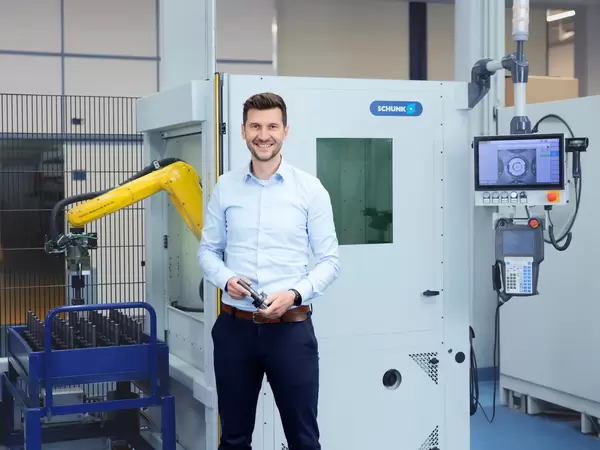
"We had a bottleneck at the end of our value stream. To address this, we wanted to find solutions to make the work more productive," says Steffen Gotzmann, production manager for toolholders and chuck jaws in Lauffen. "We took a look at our manual processes and quickly identified finishing as an area for improvement. Perfect for automation systems that SCHUNK now builds itself."
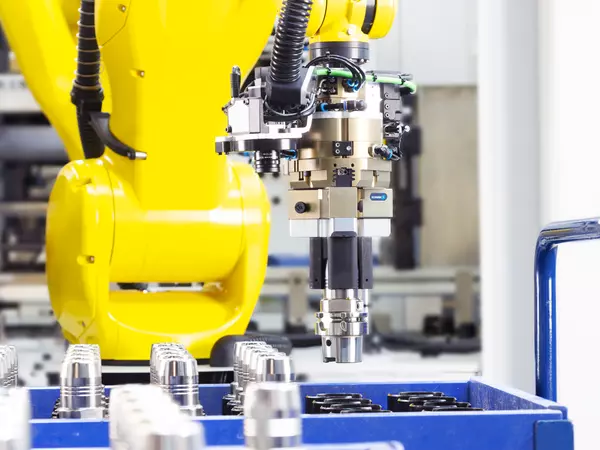
A key requirement was to maintain the existing logistics: In Lauffen, the toolholders are moved from process to process in product carts. Repackaging the products into special automation trays would have required additional manual labor and was out of the question. For this reason, the GROW automation cell was designed to adapt to the existing sequence. The cart is pushed into the logistics module, secured in place, and then identified via the production order. The cell receives all relevant information about the workpiece type, marking, and the corresponding program via a barcode.
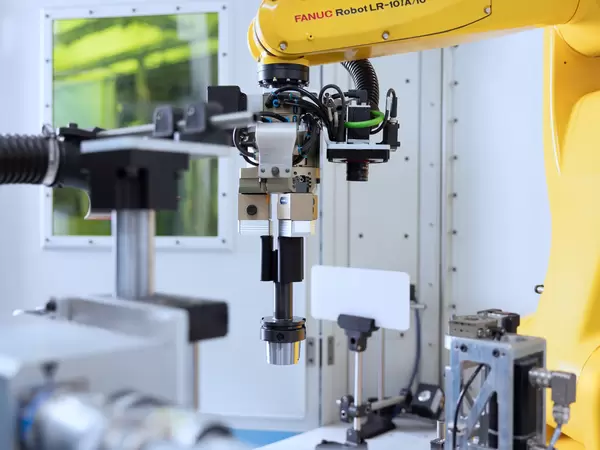
Once the process starts, the robot takes over. A camera system first detects where the toolholders are located in the cart. This is necessary because the carts and component positions do not offer the same level of precision as a tray specifically designed for automation. Image processing compensates for these deviations and makes the cell robust. The robot grips the toolholder, guides it into the cell, and uses another camera to check the component's orientation.
This orientation is crucial because toolholders have defined features, such as holes or contours, and markings must be placed at specific locations. Only once the position has been clearly determined will the component be correctly aligned with the laser. The robot can rotate the toolholder during the process, allowing it to approach multiple marking positions. The camera then checks the data matrix code: Is it readable, and does the stored information match the respective toolholder? This transforms a manual handling process into a reproducible sequence with integrated quality control.
The cell uses interchangeable gripper fingers for the form-fit grip. About 50 different gripper-finger sets are sufficient for approximately 650 variants that can be created automatically. The changeover is performed using the SCHUNK BSWS-R jaw quick-change system directly on the gripper and takes only a few minutes. Operators can also program new variants themselves. Stürmlinger was involved from the very beginning: "I was essentially there from the very start, helping to plan and develop the cell. We communicated our requirements to the development team in close collaboration with them."
Does it pay off? A look at the idle times helps here. Gotzmann explains: "Of course, we asked ourselves: Will automation pay for itself for a relatively simple processing step like laser marking? Thanks to automation, parts are now machined during idle time while the employee performs other tasks. As a result, this cell pays for itself almost as quickly as a large automation system connected to a machining center."
This also changes the role of employees. Instead of changing parts every ten seconds, they set up the cell, monitor the process, and intervene only for setup or inspection tasks. Two-thirds of the employees in the Finishing department were trained to operate and program new variants without any prior experience in robotics. Usability was therefore a key factor in success: automation has not only got to work from a technical standpoint, but also remain manageable in day-to-day production.
Following the laser marking, SCHUNK also automated the subsequent processes of oiling and packaging, which had previously been performed manually as well. This is where the advantages of the GROW cells' modular design are particularly evident. Since a single cell was not sufficient for both tasks, two cells were combined to form a larger solution. In one area, the toolholder is oiled; in the other, it is packaged and labeled.
The robot removes the parts from the product cart and feeds them into a closed oiling station. This applies a film of oil to protect the toolholders against corrosion. At the same time, a second robot feeds in packaging components. The team has also integrated the labeling process: a label printer produces the appropriate label, a vacuum gripper picks it up, and applies it to the curved surface of the package. The package is then closed and conveyed into what is called a rotary storage unit. The employee can later collect the finished units all at once and transfer them to boxes for storage.
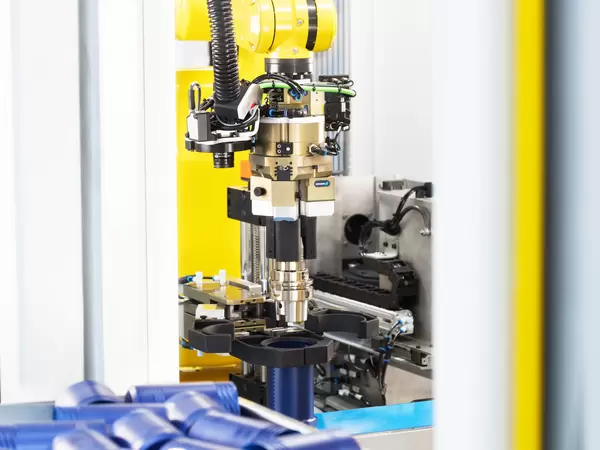
SCHUNK served as both a supplier and a user in this project. "Everything here at SCHUNK was truly developed in-house – from the initial idea to the actual implementation," says Gotzmann. The company's own manufacturing thus became the first customer for the GROW automation cells. Two laser marking cells and two oiling and packaging cells are now in operation. Several hundred toolholder variants can be automatically laser-marked, with a set-up time of about five minutes per batch. Within 24 months, a total of 135,000 toolholders were autonomously marked.
However, the real benefit lies not solely in the number of units produced: the cells eliminate a bottleneck, stabilize the process chain, and relieve employees of monotonous and physically demanding tasks. "With these automation systems, we're now creating a much calmer environment on the shop floor," Gotzmann summarizes. "The fact that employees can do something else while the system is running automatically is a major advantage and makes these cells highly cost-effective for us."
This example illustrates what matters most when automating existing manufacturing processes: the solution must adapt to the real-world production environment. It must be able to handle variants, integrate existing logistics, be quick to set up, and be accepted by the operating staff. This also makes it possible to automate processes that were long considered too fine-grained, too variant-heavy, or not sufficiently value-adding.