
In the Metaverse, complex systems can be designed, simulated and optimized faster and with less effort before they are constructed in the real world. Even service life and wear can be planned in advance. The digital twin plays a central role here. It is a crucial component in the virtual, realistic representation of production environments. However, there is still a long way to go before complete production lines and processes can be widely implemented in the metaverse. Industrial processes can only be represented transparently if all the building blocks are available in the metaverse. Initiatives such as Manufacturing-X define common standards for data exchange and create the necessary shared data spaces.
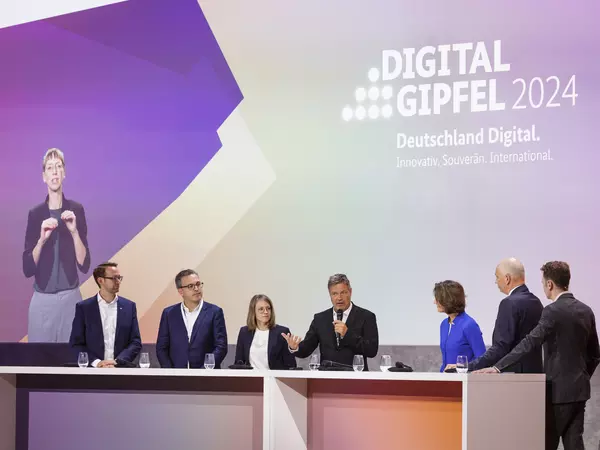
However, holistic solutions are only possible if companies of all sizes get involved. At this year's Digital Summit, Dr. Robert Habeck, Federal Minister for Economic Affairs and Climate Protection, Dr. Annika Hauptvogel, Head of Technology and Innovation Management at Siemens, Dr. Oliver Niese, Member of the Executive Board and Head of Digital Business at Festo Didactic, Dr. Eva Seidel, Business Chief Digital Officer at Bosch-Rexroth, Thomas Saueressig, Member of the Executive Board at SAP, and Henrik A. Schunk, Chairman of the Board of Directors at SCHUNK and Chairman of the Steering Committee of Industry 4.0 platform, discussed the opportunities presented by this key technology. In the panel discussion entitled "Industrial Metaverse: How the virtual world supports real production", participants highlighted its importance for the industry and demonstrated concrete approaches to solutions. Digital twins are associated with a high initial outlay, especially for SMEs. Nevertheless, all companies should address this issue in order to acquire the necessary digital expertise. "Everyone has to do their homework to create momentum. Only then can new efficiency potential be leveraged through the metaverse," emphasizes Henrik A. Schunk. To this end, SCHUNK is actively involved in the "Next Level Mittelstand" working initiative to expand networking and targeted knowledge transfer in the industry. "It's important to get started, gain experience and be brave with data," says Schunk. Ultimately, this generates opportunities for future, forward-looking development and decision-making processes. "Thanks to the Metaverse, it will in future be possible to plan plants and factories in less time and with fewer resources."

The path from a simple CAD model to a multi-layered data model that behaves exactly as it does in the real world is complex. With its first automation cells, SCHUNK is already demonstrating how real industrial processes can be virtually recreated. To this end, the company has created digital images for certain products and described their complete physical behavior, such as the speeds at which grippers open and close, gripping force curves and friction values on the contact surfaces between the gripper and the gripped object. A complete robot cell can already be developed and simulated in the metaverse using the NVDIA Omniverse. Further digital images of the 13,000 components will gradually follow. Once the initial effort has been made, systems can be designed, simulated and optimized more quickly and easily, before they are built.