
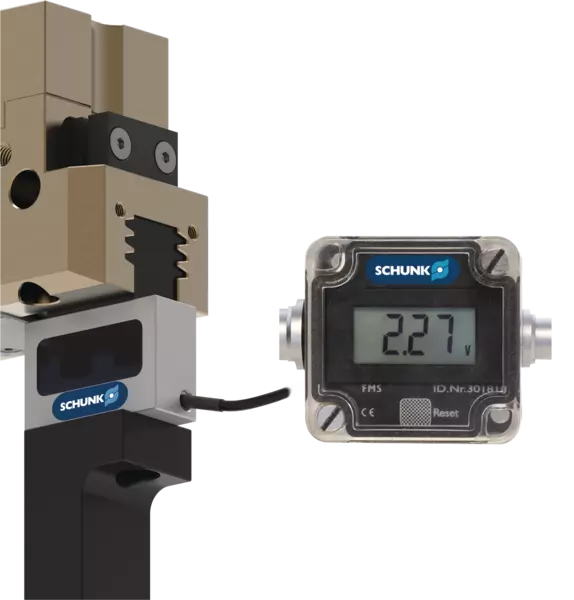
FMS
Mors de mesure de force
Ce produit est obsolète et n'est plus disponible.
Date de fin de vie : 31 mars 2020
Les mors de mesure de l'effort mesurent les forces de préhension et peuvent également déterminer le poids des pièces ou les écarts de dimensions. Il existe des mors intermédiaires actifs et passifs (FMS-ZBA ou FMS-ZBP). Un mors de mesure de l'effort actif est nécessaire par pince, les autres peuvent être passifs. Un système électronique d'évaluation FMS-A ainsi qu'un câble de raccordement FMS-AK sont nécessaires par mors actif.
Description
Advantages – Your benefits
- Easy handling
via a control line that is directly connected to a PLC - Result output via analog voltage value
- Simple, linear relationship
between output voltage and gripping force - Simple zero balancing
with button or via control line - Integrated LCD
for visual control - Easy assembly
- Hermetically sealed
for use in extreme working conditions
Options and special information
- General notes about the series
The FMS force measuring system allows measuring forces acting on the base jaw in the direction of the jaw movement. Up to three active (equipped with sensors) FMS-ZBA intermediate jaws are required for this purpose, depending on the field of application. - The remaining base jaws contain the passive FMS-ZBP intermediate jaws (without sensor systems). Each FMS-ZBA active intermediate jaw requires an FMS-A1 electronic processor for evaluation, and an FMS-AK connection cable for connecting the electronic processor to an SPC or a control cabinet.
- Range of measurement
The measuring range is the range within which the whole system has an accuracy of < 3%. The overload range is the range within which the whole system has an accuracy of > 3%. At the end of the overload range, there is the danger of the mechanical destruction of the intermediate jaw.