
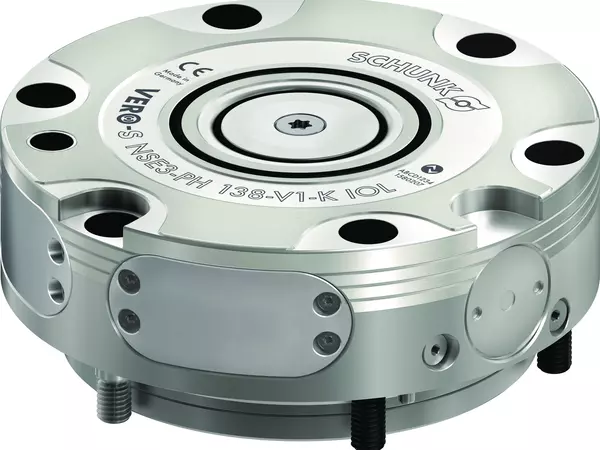
With the new battery-powered clamping device, SCHUNK offers a pioneering solution for companies that want to capture process-relevant statuses in real time and transmit them efficiently to the machine control. This technology is particularly attractive for industries looking to move away from cost-intensive pneumatic and hydraulic solutions – whether to reduce operating costs or to avoid contamination, which is absolutely undesirable in cleanrooms or the food industry.
In this new development, SCHUNK relies on IO-Link Wireless for wireless communication between the clamping device and the machine control. For the first time at EMO 2025, battery-powered TANDEM clamping force blocks of the KSE3 series as well as VERO-S quick-change pallet modules will be presented that utilize this technology. The actuation and transmission of the permanently recorded statuses of the clamping devices are carried out via IO-Link Wireless and an IO-Link Master, which then transfer this information to the machine control.
A highlight in this area is the collaboration with Blum Novotest, a specialist in BRC wireless technology. If a BLUM measuring system with BRC wireless technology is already in use, the new clamping devices from SCHUNK can be quickly and cost-effectively integrated into existing production processes. This saves time, reduces installation effort, and increases production flexibility.
Despite the switch to battery operation, users do not have to compromise on clamping force or pull-down force. On the contrary: the new clamping devices deliver the same performance as pneumatic or hydraulic systems. There are also no additional interfering contours, as the actuators and electronics are fully integrated into the clamping device. Signal processing takes place directly within the clamping module, so only the IO-Link interface needs to be connected. SCHUNK’s new battery-powered clamping devices are not only powerful but also highly efficient: up to 1,000 clamping cycles can be performed per battery charge. In this way, SCHUNK continues to pave the way toward a sustainable, resource-efficient, and highly productive future of manufacturing.