
arrow calendar cartcheck checkmark close configure contact danger download external_link facebook globeinfo instagram jobfinder linkedin logo_claim logout mail menuminus navigation pin play plus rss searchshaft success twitteruserwarning wechat x-twitterxing youku youtube zoom
Change the country selection to see information on the products, services and contact persons that are relevant for your location.
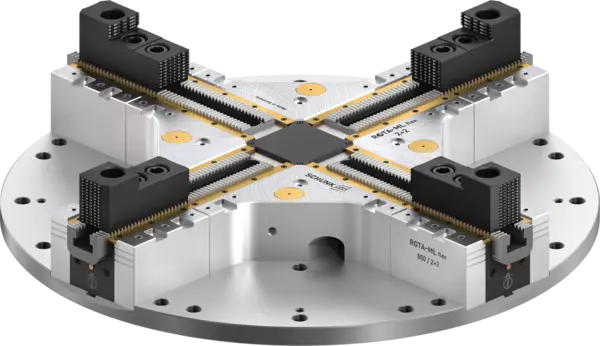
ROTA-ML flex 2+2

ROTA-ML flex 2+2

Flexible 4-jaw compensation chuck
Centrically compensating 4-jaw chuck with large compensation stroke.

Advantages – Your benefits

  • Sealed manual lathe chuck
    For significantly longer maintenance intervals
  • Patented drive concept
    Independent installation of the jaw pairs with subsequent centrically compensating workpiece clamping
  • Flexible clamping system
    For clamping round, cubic, or geometrically bulky workpieces
  • Compensation mechanism
    Enables centric clamping of any workpiece geometries
  • Optimized chuck heights and weights for the new ROTA-ML flex 2+2 versions from Ø 500 mm
    For a maximum additional payload of workpiece weight
  • High efficiency of the wedge bar system
    Process-reliable clamping due to high clamping forces
  • Lubrication system with grease circulation
    Ensures permanent grease supply for constant clamping forces
  • Visual clamping release
    As an indicator for the range in which safe clamping can be ensured
  • All sides of the functional parts are hardened and ground
    Ensures a long service life

Optionen und spezielle Informationen

  • Extrem flexibles 4-Backen-Handspannfutter
    Spannen von runden, kubischen sowie geometrisch unförmigen Teilen – alles kein Problem für das ROTA-ML flex 2+2. Dank patentiertem Antriebskonzept mit gekoppelten Backenpaaren lassen sich jegliche Werkstückgeometrien zentrisch und ohne Überbestimmtheit spannen. Die Futter finden insbesondere in Speicherlösungen und auf Fräs-Drehmaschinen Anwendung, können aber auch auf Drehmaschinen eingesetzt werden. Im Vergleich zur Vorgängerversion konnten die Futtergewichte der großen Futter ab Ø 500 mm um bis zu 40 % reduziert werden, so dass ein noch höheres Werkstückgewicht dazugeladen werden kann.