For many years, feiba Engineering & Plants GmbH has been an expert and supplier of special-purpose machinery, and a trusted partner to the industry when it comes to automating welding and joining processes – with a clear focus on joining aluminum and steel parts. Besides state-of-the-art welding technologies, stamping, brushing, and polishing are part of their day-to-day operations. Their service portfolio ranges from automating individual cells to integrated, flexibly reconfigurable production lines and prototype cells, including fixtures and tooling.
In the customer’s production environment, the recurring challenge has been the safe and reliable handling of profiles made of different materials (plastic, aluminum, steel, etc.) with varying dimensions, surfaces, and stiffnesses. Key requirements included high precision and repeatability at short cycle times, as well as robust processes even for long, limp, flexible components. The system also needed to be easy to customize for customer-specific systems.
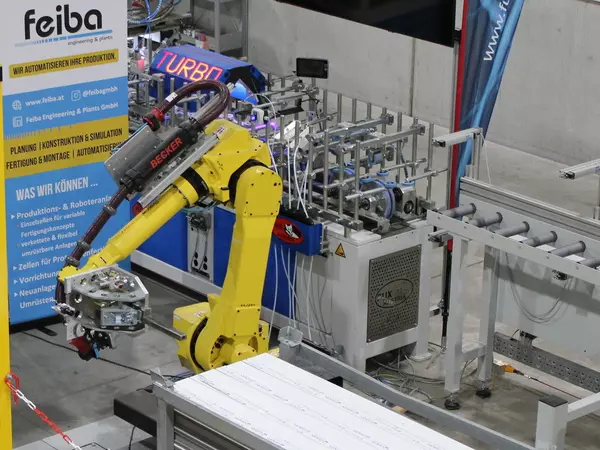
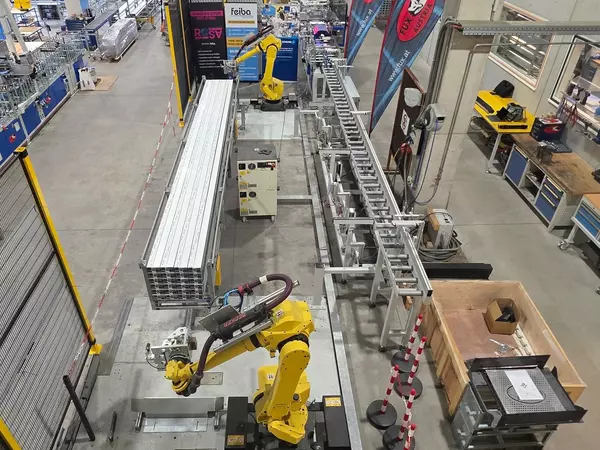
Feiba relies on ROSA (Robot Smart Automation) for profile handling - a specially developed, patented system for handling hollow-chamber and solid profiles. ROSA can be modularly integrated into upstream and downstream processes and customized to individual requirements. At its core is an advanced camera system with profile engagement: It detects the exact position of the profiles in a fraction of a second and initiates the gripping operation. Depending on the profile length and elasticity, ROSA uses one or two robots to reliably move limp or rigid workpieces. The system handles up to 12-meter-long profiles at cycle times of up to 10 seconds.
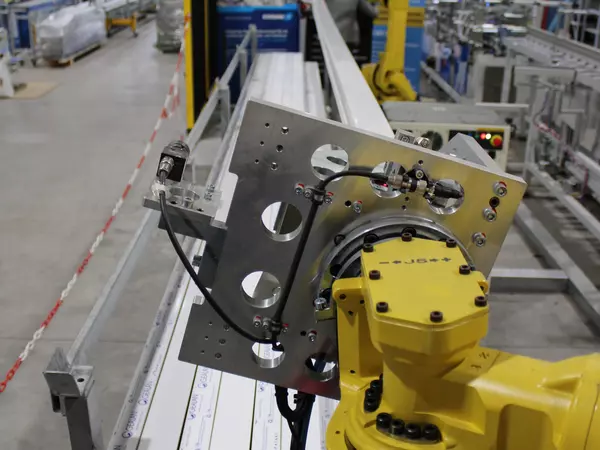
ROSA places high demands on gripping technology: Long components generate high lever forces and vibrations at the gripper. At the same time, the system must prevent damage to sensitive surfaces and securely grip a wide range of profile geometries. The gripping solution must allow for long finger lengths, absorb high torque loads, and remain lightweight.
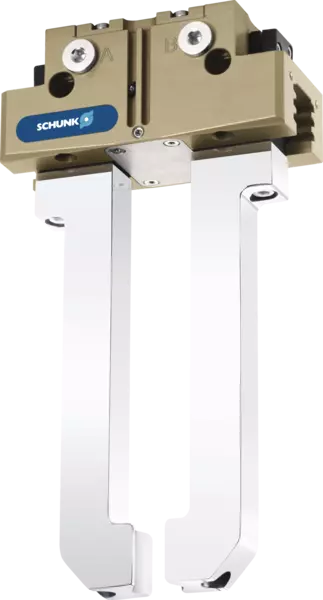
“The challenge in gripping technology was the high torque loads caused by the long components. By using the PGN-plus-P gripper featuring a multi-tooth guidance, we were able to achieve an optimal solution,” says Roland Vass, Technical Sales, Gripping and Automation Technology. The decisive factors were the high gripping force in a compact design, combined with maximum process reliability and repeatability. Moreover, SCHUNK gripping systems are designed for continuous industrial operation and enable fast, flexible changeovers through quick replacement of the gripping mechanism. The gripping solution for ROSA uses the SCHUNK PGN-plus-P 240-1 gripper. It is a compact gripper with high gripping force and low weight, which, thanks to its patented multi-tooth guidance, can absorb high forces and moments. The multi-tooth sliding guidance also allows the mounting of very long gripper fingers. For position monitoring, MMS sensors are used for two positions. In robotics, ROSA relies on efficient repositioning and handover processes with an acceleration of 2 m/s², enabling dynamic motion sequences.
ROSA with SCHUNK grippers is used in numerous industries, including manufacturers of windows, doors, profile manufacturers, and suppliers to the furniture industry. FUX Maschinenbau develops and manufactures innovative systems for profile and window manufacturing. Here, ROSA provides precise handling of profiles to load laminating machines. The laminating machine continuously wraps profiles made of plastic, PVC, wood, metal, and aluminum with films and foils from roll stock. SCHUNK grippers ensure form-fit and force-fit gripping of numerous profile geometries, prevent sensitive surfaces from being damaged, and allow the quick exchange of gripping systems when variants change. The result of using ROSA for profile handling is predictable processes, reduced setup times, and high system availability.
The combination of ROSA and SCHUNK grippers enables highly flexible, process-reliable handling of hollow-chamber and solid profiles of more than 12 meters in length. Thanks to intelligent image processing, compact high-performance grippers, and modular tool-changing systems, changing requirements in series production and high-mix operation are reliably met. Monotonous and physically demanding tasks are automated, providing ergonomic relief for employees. In addition, users benefit from reduced throughput times, increased flexibility, and maximum system performance.