
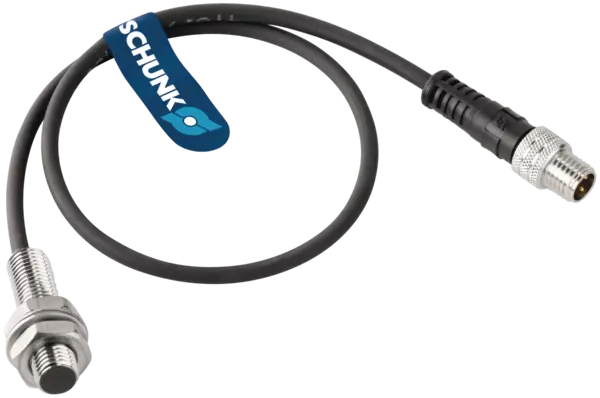
IN 80-S-M8
Induktive Näherungsschalter
Ident.-Nr. 301478
Induktiver Näherungsschalter IN
- Anzahl Schaltpunkte: 1
- Schaltabstand: 1.5 mm
- Zylindrischer Sensor
- Gewinde Sensor: M8x1
- Schaltart: PNP
- Schließer
- Kabellänge: 30 cm
- Elektrischer Anschluss: M8-Stecker, 3-polig
- Nennspannung: 24 V
Technische Details
| Messprinzip | induktiv |
|---|---|
| Schaltfunktion | Schließer |
| Schaltungsart | PNP |
| Anzahl Schaltpunkte | 1 |
| Schaltabstand [mm] | 1.5 |
| Schalthysterese vom Nennschaltabstand | < 15% |
| Max. Schaltfrequenz [Hz] | 3000.0 |
| Min. Umgebungstemperatur [°C] | -25.0 |
| Max. Umgebungstemperatur [°C] | 70.0 |
| LED-Anzeige am Sensor | ja |
| Spannungsart | DC |
| Nennspannung | 24.0 |
| Min. Betriebsspannung | 10.0 |
| Max. Betriebsspannung | 30.0 |
| Spannungsabfall [V] | 1.8 |
| Max. Schaltstrom | 0.15 |
| Kurzschlussschutz | ja |
| Verpolungssicher | ja |
| Werkstoff Gehäuse | Edelstahl |
| Kabelstecker/Kabelende | M8-Stecker, 3-polig |
| Kabellänge L [cm] | 30.0 |
| Kabeldurchmesser D [mm] | 3.0 |
| Kabelaufbau (Aderquerschnitt/Anzahl Adern) | 3x 0,14mm2 |
| Werkstoff Kabelummantelung | PUR |
| Min. Biegeradius (dynamisch) [mm] | 30.0 |
| Min. Biegeradius (statisch) [mm] | 15.0 |
| Eigenmasse [kg] | 0.023 |
| Schutzart IP (Sensor, gesteckt) | 67 |
| Schutzklasse | III |
| Bohremulsionsresistenz * | ja |
*Getestete Bohremulsionen: r.rhenus TU 43P, Motorex Swisscool Magnum UX 550 und Oemeta 760 (1008339).
Allgemeine Hinweise zur Baureihe
SCHUNK Greif- und Drehmodulen, sowie Linearachsen und Roboterzubehör-Komponenten sind stets mit den dazu passenden Sensoren von SCHUNK abzufragen, da diese bestmöglich aufeinander abgestimmt sind.
Wenn die wesentlichen Eigenschaften wie Schaltabstand, Schaltfunktion, Hysterese und Spannung hinreichend gleich sind, können im Allgemeinen statt der induktiven Näherungsschalter (IN, INK) von SCHUNK auch Näherungsschalter anderer Hersteller eingesetzt werden.
Sensoren anderer Hersteller in SCHUNK Produkten liefern daher in den seltensten Fällen befriedigende Schaltergebnisse. Ebenso kann weder deren Funktion noch deren Funktionssicherheit garantiert werden.