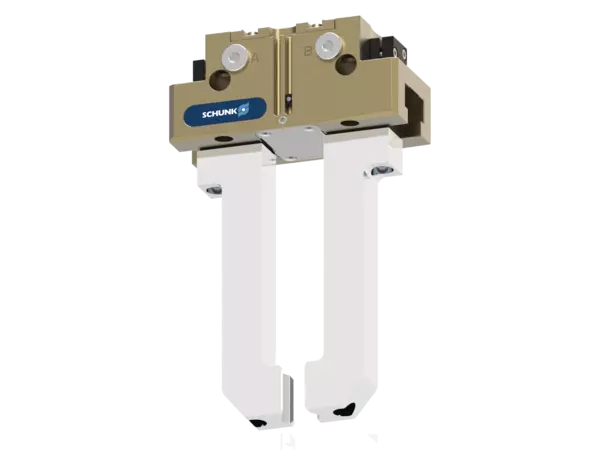
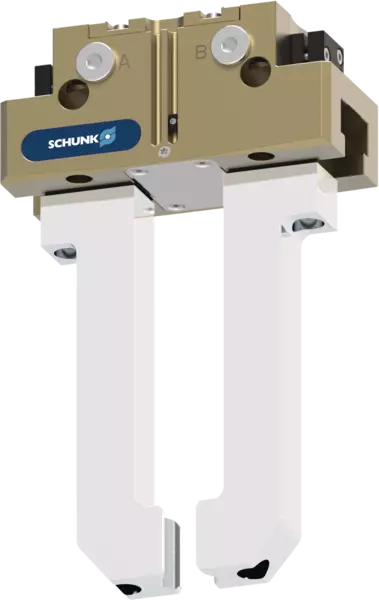
JGP-P
Function
Disegno in sezione
Disegno in sezione
Il pistone viene spinto verso il basso e verso l'altro dall'aria compressa.
Le superfici dei piani inclinati producono un movimento della griffa sincrono e parallelo.
- 1
-
Guida di scorrimento con scanalatura a T
Guida della griffa in grado di sostenere carichi, resistente per griffe lunghe - 2
-
Griffa
con piano di fissaggio standardizzato per il collegamento di griffe della pinza specifiche per il pezzo - 3
-
Staffa per sensori
Supporti per interruttori di prossimità e camme di commutazione regolabili nel corpo - 4
-
Corpo
a peso ridotto grazie all'impiego di lega di alluminio anodizzata dura e ad alta resistenza - 5
-
Possibilità di centraggio e montaggio
per il montaggio universale della pinza - 6
-
Sistema a piani inclinati
superfici a piani inclinati più ampie consentono un'elevata trasmissione della potenza e usura minima - 7
-
Pistoni
Massima forza grazie alla massima superficie del pistone di comando
Versione AS/IS per il mantenimento della forza di presa
Settings of the control cams during monitoring with inductive proximity switches
Optional mounting possibility under the cover sheet for customer-specific additional structure
Versione AS/IS per il mantenimento della forza di presa
Il dispositivo di mantenimento meccanico della forza di presa garantisce un forza minima di presa anche in caso di perdita di pressione. Nella variante AS questa agisce come forza di chiusura, e nella variante IS come forza di apertura. La seguente immagine mostra la variante AS. Il mantenimento della forza di presa si può usare anche per aumentare la forza stessa di presa o semplicemente per una presa a effetto semplice.
- 1
-
Guida di scorrimento con scanalatura a T
- 2
-
Griffa
- 3
-
Staffa per sensori
- 4
-
Corpo
- 5
-
Possibilità di centraggio e montaggio
- 6
-
Sistema a piani inclinati
- 7
-
Kolben
- 8
-
Gripping force maintenance
Settings of the control cams during monitoring with inductive proximity switches
Monitoring with inductive proximity switch can be performed as standard from size 64. In delivery state, the positions "gripper open" and "gripper closed" are preset with the control cams. The inductive sensors must be ordered separately and are slid into the housing up to the stop and clamped.
In order to monitor any other position, such as "workpiece gripped" for example, both control cams can be individually set in the respective base jaws.
- 1
-
Control cam preset for "gripper closed" position
- 2
-
Control cam preset for "gripper open" position
- 3
-
Holder with clamping screw for fixing the sensor
- 4
-
Clamping screw for process-reliable fixing of the adjusted switching point
- 5
-
Adjusting screw for setting any switching point
Optional mounting possibility under the cover sheet for customer-specific additional structure
In delivery state, a cover sheet is mounted to the gripper. This can be removed if necessary. Under the cover sheet are threads and fittings for mounting customer-specific designs for implementing additional functions.
- 1
-
Additional centering or support of the workpiece
- 2
-
The cover plate (can be removed)
- 3
-
Ejector with external cylinder attached to the gripper
Application example
Application example
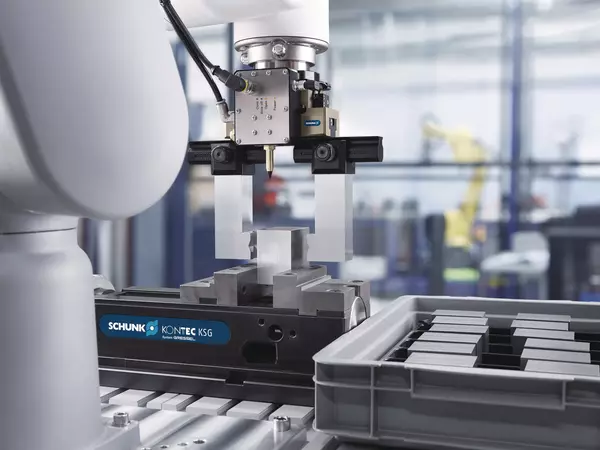
Loading and unloading of a machine tool optimized for the cycle time. By using two grippers on the robot, the machine tool can be loaded automatically in a way that is optimized for the cycle time, and productivity can be increased. After the finished part has been removed from the first gripper, the automated clamping force block is cleaned of coolant and chips via the integrated blow-off nozzle of the double gripper. After that, the second gripper can directly insert the unmachined part and the machining process can be started. The finished part is then deposited and the next unmachined part is picked up again in parallel with the machining of the workpiece.
- 1
-
2-finger parallel gripper JGP-P
- 2
-
TANDEM PGS3 clamping force block