功能
Funktionsschnittbild
Der Kolben wird über Druckluft nach oben bzw. unten bewegt.
Die schrägen Wirkflächen des Keilhakens erzeugen dabei eine synchrone parallele Backenbewegung.
- 1
-
T-Nuten-Gleitführung
belastbare, widerstandsfähige Grundbackenführung für große Fingerlängen - 2
-
Grundbacke
mit standardisiertem Anschraubbild zur Adaption der werkstückspezifischen Greiferfinger - 3
-
Halterung für Sensorik
Halterungen für Näherungsschalter und einstellbare Schaltnocken im Gehäuse - 4
-
Gehäuse
ist gewichtsoptimiert durch Verwendung einer hochfesten Aluminiumlegierung - 5
-
Zentrier- und Befestigungsmöglichkeiten
für die universelle Montage des Greifers - 6
-
Keilhakenprinzip
für hohe Kraftübertragung und niedrigsten Verschleiß durch größere Schrägzugfläche - 7
-
Kolben
Maximale Kraft durch maximale Fläche des Antriebkolbens
Greifkrafterhaltungs-Version AS/IS
Settings of the control cams during monitoring with inductive proximity switches
Optional mounting possibility under the cover sheet for customer-specific additional structure
Centering and mounting options for gripper assembly
Pneumatic connections for the power supply
Greifkrafterhaltungs-Version AS/IS
Die mechanische Greifkrafterhaltung stellt auch bei Druckabfall eine Mindestgreifkraft sicher. Diese wirkt bei der AS-Variante als Schließkraft und bei der IS-Variante als Öffnungskraft. Das Bild zeigt die AS-Variante. Die Greifkrafterhaltung lässt sich auch als Greifkrafterhöhung oder für einfach wirkendes Greifen nutzen.
- 1
-
T-Nuten-Gleitführung
- 2
-
Grundbacke
- 3
-
Halterung für Sensorik
- 4
-
Gehäuse
- 5
-
Zentrier- und Befestigungsmöglichkeiten
- 6
-
Keilhakenprinzip
- 7
-
Kolben
- 8
-
Greifkrafterhaltung
Settings of the control cams during monitoring with inductive proximity switches
Monitoring with inductive proximity switch can be performed as standard from size 64. In delivery state, the positions "gripper open" and "gripper closed" are preset with the control cams. The inductive sensors must be ordered separately and are slid into the housing up to the stop and clamped.
In order to monitor any other position, such as "workpiece gripped" for example, both control cams can be individually set in the respective base jaws.
- 1
-
Control cam preset for "gripper closed" position
- 2
-
Control cam preset for "gripper open" position
- 3
-
Holder with clamping screw for fixing the sensor
- 4
-
Clamping screw for process-reliable fixing of the adjusted switching point
- 5
-
Adjusting screw for setting any switching point
Optional mounting possibility under the cover sheet for customer-specific additional structure
In delivery state, a cover sheet is mounted to the gripper. This can be removed if necessary. Under the cover sheet are threads and fittings for mounting customer-specific designs for implementing additional functions.
- 1
-
Additional centering or support of the workpiece
- 2
-
The cover plate (can be removed)
- 3
-
Ejector with external cylinder attached to the gripper
Centering and mounting options for gripper assembly
The gripper can be installed on two sides and in three screw directions. This allows universal and flexible mounting of the gripper in all conceivable arrangements.
Pneumatic connections for the power supply
The gripper can be flexibly supplied with compressed air on three sides.
- 1
-
At the front via the main air connections A and B by means of air connections and pneumatic hoses. Air purge can be optionally created via S.
- 2
-
At the bottom via direct connections a and b by means of hose-free direct connection. The pneumatic supply is then provided via the adapter plate.
- 3
-
At the rear side via direct connections a and b by means of hose-free direct connection. The pneumatic supply is then via the adapter plate. Air purge can be optionally created via s.
Application example
Application example
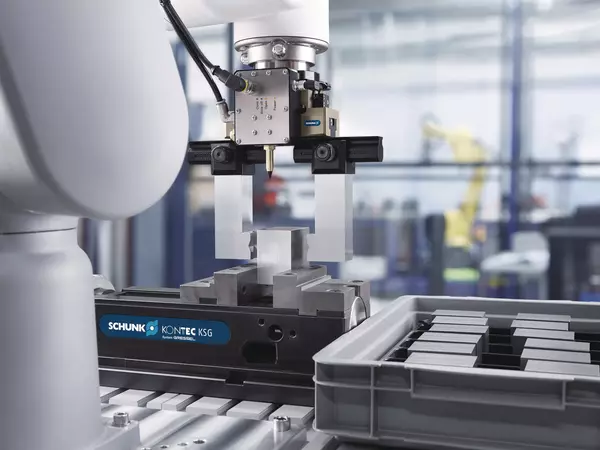
Loading and unloading of a machine tool optimized for the cycle time. By using two grippers on the robot, the machine tool can be loaded automatically in a way that is optimized for the cycle time, and productivity can be increased. After the finished part has been removed from the first gripper, the automated clamping force block is cleaned of coolant and chips via the integrated blow-off nozzle of the double gripper. After that, the second gripper can directly insert the unmachined part and the machining process can be started. The finished part is then deposited and the next unmachined part is picked up again in parallel with the machining of the workpiece.
- 1
-
2-finger parallel gripper JGP-P
- 2
-
TANDEM PGS3 clamping force block