JGP-P
Functie
Diagrama seccional
Diagrama seccional
O pistão é movido para cima e para baixo por ar comprimido.
As superfícies ativas angulares do gancho em cunha produzem um movimento sincronizado e paralelo da castanha.
- 1
-
Guia da ranhura em T
guia da castanha base robusta e carregável para dedos de garra extremamente longos - 2
-
Castanha base
com esquema de conexão aparafusado padronizado para a conexão dos dedos das garras específicas da peça - 3
-
Bracket for sensors
Suportes para interruptores de proximidade e cames de controle ajustáveis na carcaça - 4
-
Housing
is weight-optimized due to the use of high-strength aluminum alloy - 5
-
Centering and mounting possibilities
for universal assembly of the gripper - 6
-
Wedge-hook design
for high power transmission and minimal wear as a result of larger diagonal pull surfaces - 7
-
Piston
Maximum force through maximum surface of drive piston
Gripping force maintenance version AS/IS
Settings of the control cams during monitoring with inductive proximity switches
Optionele bevestigingsmogelijkheid onder de afdekplaat voor klantspecifieke aanvullende structuur
Centering and mounting options for gripper assembly
Pneumatic connections for the power supply
Gripping force maintenance version AS/IS
The mechanical gripping force maintenance device ensures that a minimum clamping force will be applied even if there is a drop in pressure. In the AS version this acts as a closing force, and in the IS version as an opening force. The image shows the AS version. The gripping force maintenance can also be used to increase the gripping force or for one-way gripping.
- 1
-
T-slot guidance
- 2
-
Base jaw
- 3
-
Bracket for sensors
- 4
-
Housing
- 5
-
Centering and mounting possibilities
- 6
-
Wedge-hook design
- 7
-
Piston
- 8
-
Gripping force maintenance
Settings of the control cams during monitoring with inductive proximity switches
Monitoring with inductive proximity switch can be performed as standard from size 64. In delivery state, the positions "gripper open" and "gripper closed" are preset with the control cams. The inductive sensors must be ordered separately and are slid into the housing up to the stop and clamped.
In order to monitor any other position, such as "workpiece gripped" for example, both control cams can be individually set in the respective base jaws.
- 1
-
Control cam preset for "gripper closed" position
- 2
-
Control cam preset for "gripper open" position
- 3
-
Holder with clamping screw for fixing the sensor
- 4
-
Clamping screw for process-reliable fixing of the adjusted switching point
- 5
-
Adjusting screw for setting any switching point
Optionele bevestigingsmogelijkheid onder de afdekplaat voor klantspecifieke aanvullende structuur
Bij levering is een afdekking op de grijper gemonteerd. Indien nodig, kan dit worden verwijderd. Onder de afdekking bevinden zich schroefdraad en fittings voor de montage van klantspecifieke uitvoeringen om extra functies te implementeren.
- 1
-
Extra centrering of ondersteuning van het werkstuk
- 2
-
De afdekplaat (kan worden verwijderd)
- 3
-
Ejector met externe cilinder bevestigd aan de grijper
Centering and mounting options for gripper assembly
The gripper can be installed on two sides and in three screw directions. This allows universal and flexible mounting of the gripper in all conceivable arrangements.
Pneumatic connections for the power supply
The gripper can be flexibly supplied with compressed air on three sides.
- 1
-
At the front via the main air connections A and B by means of air connections and pneumatic hoses. Air purge can be optionally created via S.
- 2
-
At the bottom via direct connections a and b by means of hose-free direct connection. The pneumatic supply is then provided via the adapter plate.
- 3
-
At the rear side via direct connections a and b by means of hose-free direct connection. The pneumatic supply is then via the adapter plate. Air purge can be optionally created via s.
Application example
Application example
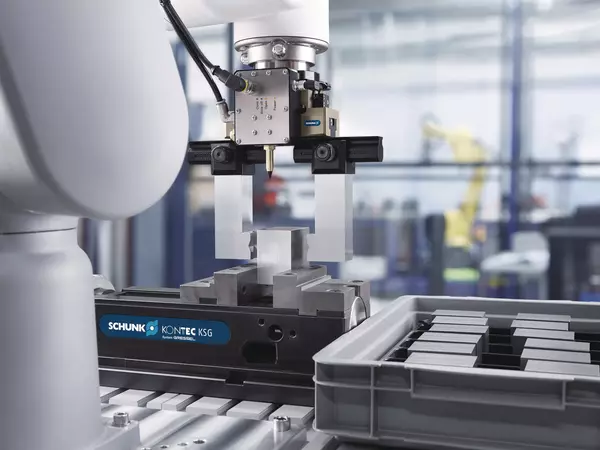
Loading and unloading of a machine tool optimized for the cycle time. By using two grippers on the robot, the machine tool can be loaded automatically in a way that is optimized for the cycle time, and productivity can be increased. After the finished part has been removed from the first gripper, the automated clamping force block is cleaned of coolant and chips via the integrated blow-off nozzle of the double gripper. After that, the second gripper can directly insert the unmachined part and the machining process can be started. The finished part is then deposited and the next unmachined part is picked up again in parallel with the machining of the workpiece.
- 1
-
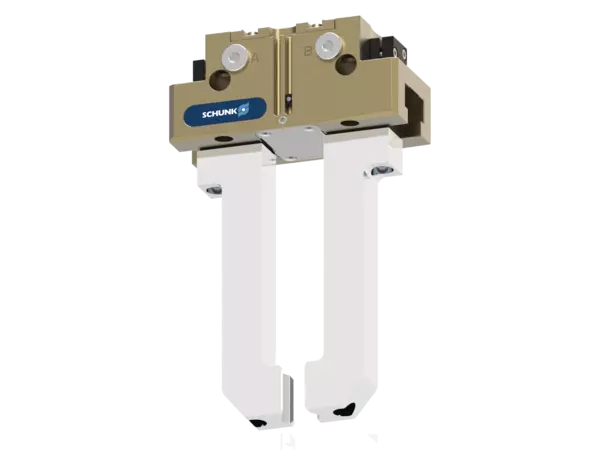
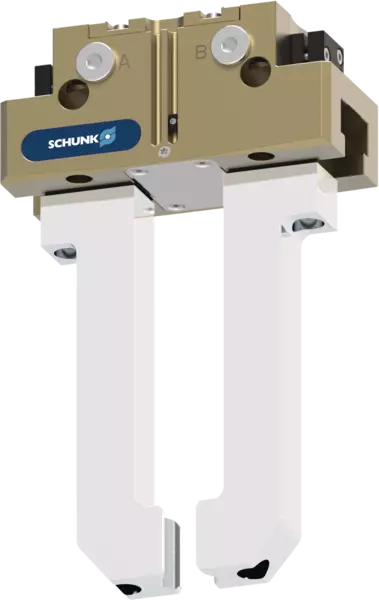
2-finger parallel gripper JGP-P
- 2
-
TANDEM PGS3 clamping force block