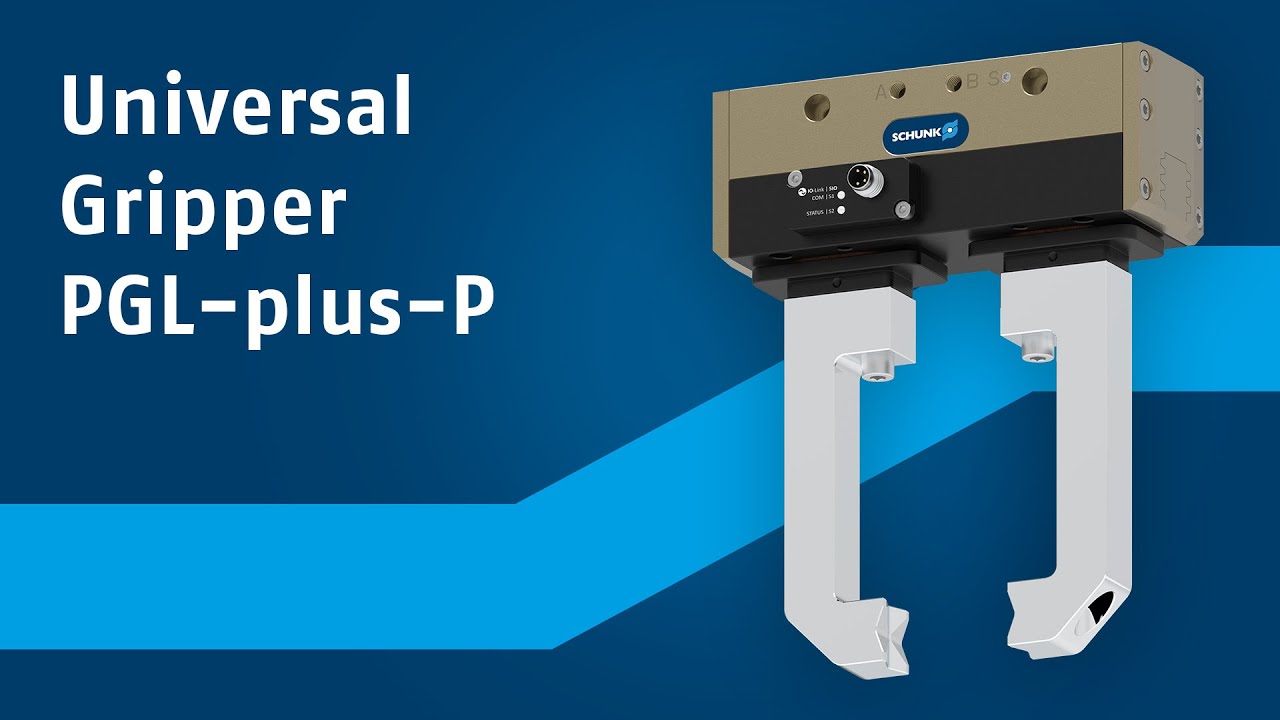

PGL-plus-P
Fonction
Sectional diagram
Sectional diagram
By applying pressure to the opposing drive pistons, the multi-tooth guided base jaws are directly driven via a drive type fastening. The jaw stroke is synchronized by means of rack-and-pinion kinematics. This ensures powerful and centric opening and closing of the gripper.
- 1
-
Base jaw
with standardized screw connection diagram for the connection of the workpiece-specific gripper fingers The centering sleeves are attached so that they cannot be lost when exchanging fingers - 2
-
Multi-tooth guidance
Maximum service life due to lubricant pockets in the robust multi-tooth guidance, and absorption of high forces and torques by means of the large guidance support - 3
-
driver
Direct power transmission of the drive pistons to the gripper fingers via a robust drive type fastening - 4
-
Kinematics
The gear rack-and-pinion kinematics ensure synchronization of the base jaws and centric clamping - 5
-
Pneumatic drive piston
Maximum power generation through two oval pneumatic pistons - 6
-
Dust cover
The entire circumference of the gripper is encapsulated with metal and additionally sealed with a lip seal at the base jaws so that it is suitable for universal use, even in dirty environments.
Gripping force maintenance version AS/IS
GripGuard: secure, certified gripping force maintenance version ASC/ISC
Certified gripping force maintenance
Integrated sensor system IOL
External sensor system with magnetic switches
External sensor system with inductive proximity switches
Precision version P
Optional mounting options for customized add-ons
Centering and mounting options for gripper assembly
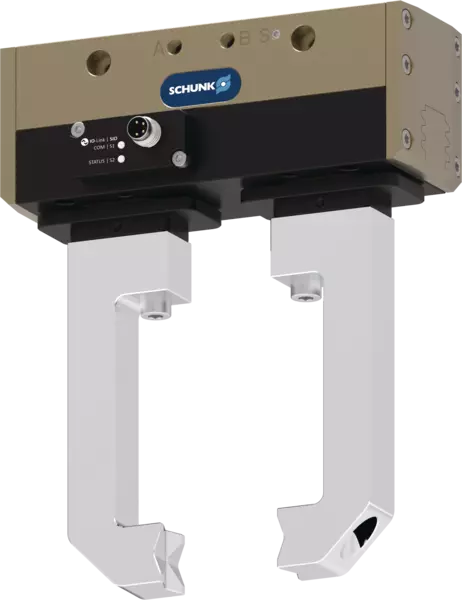
Pneumatic connections for the power supply
Gripping force maintenance version AS/IS
Conventional gripping force maintenance via springs also ensures a minimum gripping force in case of a pressure drop. In the AS variant this acts as a closing force, and in the IS variant as an opening force. The image shows the AS variant. The gripping force maintenance can also be used to increase the gripping force or for single actuated gripping.
- 1
-
Base jaw
with standardized screw connection diagram for the connection of the workpiece-specific gripper fingers The centering sleeves are attached so that they cannot be lost when exchanging fingers - 2
-
Multi-tooth guidance
Maximum service life due to lubricant pockets in the robust multi-tooth guidance, and absorption of high forces and torques by means of the large guidance support - 3
-
driver
Direct power transmission of the drive pistons to the gripper fingers via a robust drive type fastening - 4
-
Kinematics
The gear rack-and-pinion kinematics ensure synchronization of the base jaws and centric clamping - 5
-
Pneumatic drive piston
Maximum power generation through two oval pneumatic pistons - 6
-
Dust cover
The entire circumference of the gripper is encapsulated with metal and additionally sealed with a lip seal at the base jaws so that it is suitable for universal use, even in dirty environments. - 7
-
Gripping force maintenance by means of a pressure spring
Conventional gripping force maintenance via springs also ensures a minimum gripping force in case of a pressure drop. In the AS variant this acts as a closing force, and in the IS variant as an opening force. The image shows the AS variant. The gripping force maintenance can also be used to increase the gripping force or for single actuated gripping.
GripGuard: secure, certified gripping force maintenance version ASC/ISC
Secure GripGuard gripping force maintenance also ensures a permanent min. gripping force of 80%, even in case of a pressure drop. In the ASC variant this acts as a closing force, in the ISC variant as an opening force. Compared to conventional gripping force maintenance via springs, this GripGuard variant thereby ensures a significantly higher gripping force. In addition, the gripping force maintenance is constant over the entire jaw stroke. There is also no risk of injury with this gripper, as the base jaws do not move uncontrollably in the event of pressure drop. This simplifies the risk assessment, since gripping force maintenance is already certified as a safety function (PLd Cat. 3).
- 1
-
Base jaw
- 2
-
Multi-tooth guidance
- 3
-
driver
- 4
-
Kinematics
- 5
-
Pneumatic drive piston
- 6
-
Dust cover
- 7
-
Pinion shaft
The one-piece pinion shaft connects the pinion of the jaw synchronization with the mechanics of safe gripping force maintenance. - 8
-
Clamping element
In the event of a pressure drop where a workpiece is not gripped, the clamping element will prevent the pinion from rotating. This prevents any potentially dangerous movements of the gripper fingers. - 9
-
Elastomer
In the event of a pressure drop while gripping the workpiece, the gripping force accumulated in the elastomer (energy storage) will retain the workpiece securely. The clamping element prevents the gripper fingers from opening in such cases. - 10
-
Spring-loaded pneumatic piston
In normal gripper operation, the pneumatic piston is always actuated with compressed air. This does not require a separate air supply. In the event of a malfunction, i.e. a sudden pressure drop, the piston is pushed back via the spring assembly and the clamping element blocks the pinion shaft so that movement of the gripper fingers is no longer possible - 11
-
Pressure compensating valve
The pressure compensation valve ensures any excess pressure that has accumulated inside can escape to the outside. At the same time, it prevents dirt or liquids from entering the inside from the outside.
Certified gripping force maintenance
The certificate was issued by the German Social Accident Insurance (DGUV). The DGUV test certificate confirms the secure GripGuard gripping force maintenance in case of a power failure for the gripper series PGL-plus-P in the versions ASC and ISC. The gripping systems comply with the relevant provisions of Directive 2006/42/EC (Machinery Directive). The safety function is implemented with category 3 and PLd according to EN ISO 13849-1:2015.
Integrated sensor system IOL
The gripper variant "IOL" with integrated sensor system enables precise and process-reliable monitoring of the complete gripper stroke via IO-Link. There is no longer any need for separate procurement, installation and adjustment of additional, externally mounted sensors. In addition to IO-Link standards such as temperature display and process parameters, this integrated sensor system offers two additional modes as standard that are perfectly tailored to gripping applications: Gripping Point Mode and Gripping Range Mode. Up to eight workpieces (positions or ranges) can be stored directly in the sensor profile. Tolerance and hysteresis values are already stored in the sensor profile, but can be set individually if required. However, due to the default values, this is not necessary in most cases.
External sensor system with magnetic switches
For monitoring with magnetic switches, the gripper is equipped with two sensor slots. There is a choice of different sensors: 1-point switches, 2-point switches or else compact analog sensors for mounting in the C-slot. The image shows the "gripper open" and "gripper closed" position query with two MMS 22 sensors.
External sensor system with inductive proximity switches
The "IN" gripper variant is supplied with the pre-assembled attachment kit for two inductive proximity switches. The positions "gripper open" and "gripper closed" are preset. Proximity switches must be ordered separately and are slid into the housing as far as the stop and clamped. Both sensors can be set individually to monitor any other position such as "workpiece gripped" for example. Optionally, another attachment kit for two additional inductive proximity switches can be inserted at the back of the gripper, so that a total of four sensors can be mounted.
Precision version P
With the "P" precision version of the gripper, the base jaws are reworked on the fully assembled gripper. As a result, tolerance-related deviations can be compensated and the most precise position, form and location tolerances can be achieved. This enables highly precise gripping applications or positionally accurate change of grippers without any re-alignment.
Optional mounting options for customized add-ons
On the top of the gripper, four threads and fits are available. If required, these can be used to fasten customized designs or implement additional functions. The image shows an example of a design with additional centering or support of a workpiece.
Centering and mounting options for gripper assembly
The gripper can be installed on two sides and in four screw directions. This allows universal and flexible mounting of the gripper in all conceivable arrangements.
Pneumatic connections for the power supply
The gripper can be flexibly supplied with compressed air on three sides.
- 1
-
At the front via the main air connections A and B by means of air connections and pneumatic hoses. Air purge can be optionally created via S.
- 2
-
At the bottom via direct connections a and b, by means of tubeless direct connection and using the O-rings supplied. The pneumatic supply is then via the adapter plate. Air purge can be optionally created via s.
- 3
-
At the rear side via direct connections a and b, by means of tubeless direct connection and using the O-rings supplied. The pneumatic supply is then via the adapter plate. Air purge can be optionally created via s.
Application example
Application example
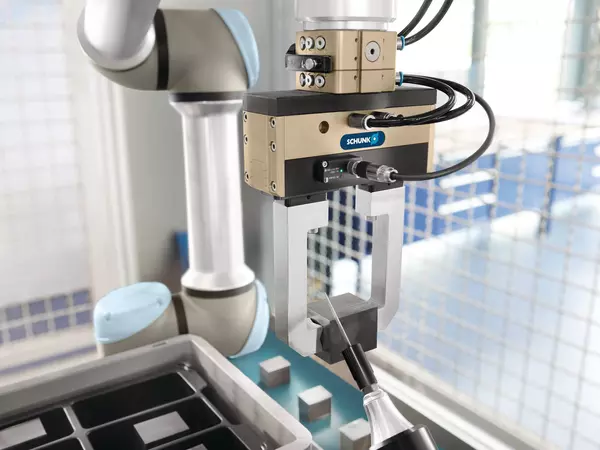
In addition to ordinary handling processes, the robust and dirt-protected universal gripper PGL-plus-P can also be used to hold workpieces during simple machining operations. In the example shown, a workpiece is being held between the gripper fingers. A robot moves the workpiece along a stationary deburring spindle for deburring. The connected air purge prevents dirt from entering the gripper.
- 1
-
Universal Gripper PGL-plus-P
- 2
-
Deburring spindle RCV
- 3
-
Pneumatic file tool CRT